
What Your Omega3 Index Can (and Can’t) Tell You About cPLA2 Activity in APOE4 Carriers

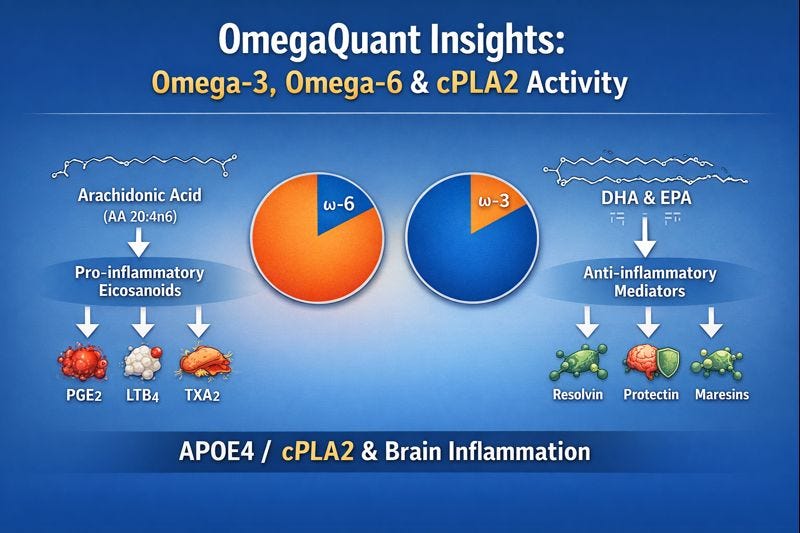
APOE4 carriers show early and sustained alterations in brain lipid metabolism that precede clinical Alzheimer’s disease by decades. One pathway consistently implicated is cytosolic phospholipase A2 (cPLA2), an enzyme that releases polyunsaturated fatty acids from membrane phospholipids and initiates downstream inflammatory signaling. I’ve been writing about this ever since I came across Hussein Yassine’s great research in early 2026 and many of you have been as interested as I have! So today, let’s continue to learn and perhaps find any actions we can take, given what we’ve learned about this nefarious “Omega Depleter” we were born with as APOE4 carriers. In this article I will discuss what, if any, information we can glean from testing of one’s complete Omega Index, which is available from OmegaQuant (link at bottom of post).
Compared to APOE3 carriers, APOE4 carriers exhibit greater basal phosphorylation and activation of cPLA2, along with increased oxidative stress and eicosanoid production. These processes have been linked not only to amyloid and tau pathology, but also to earlier mood and cognitive symptoms.
OmegaQuant (the Godfather of the Omega3 Index)testing does not measure cPLA2 activity directly. However, it provides insight into membrane fatty acid composition, which strongly influences the biological consequences of cPLA2 activation. Used appropriately, OmegaQuant can help estimate inflammatory potential, though it can’t provide us direct enzyme kinetics.
Why Membrane Lipids Matter for cPLA2
cPLA2 activity does not occur in isolation. Its downstream effects depend on:
The fatty acids present in membrane phospholipids
The balance between pro- and anti-inflammatory substrates
The availability of omega-3–derived lipid mediators and antioxidant signaling
In APOE4 carriers, heightened cPLA2 responsiveness means that identical membrane lipid profiles may produce more inflammatory signaling than in non-carriers.
Interpreting OmegaQuant Through a cPLA2 Lens
Keep reading with a 7-day free trial
Subscribe to NeuroLipid Notebook to keep reading this post and get 7 days of free access to the full post archives.