
The Castle Under Siege
A Lay Reader's Guide to APOE4's Kill Switches

Imagine your brain cell is a castle under siege. Three defenses fail. One executioner awakens. A lay reader's guide to how APOE4 loads three neuronal death pathways…
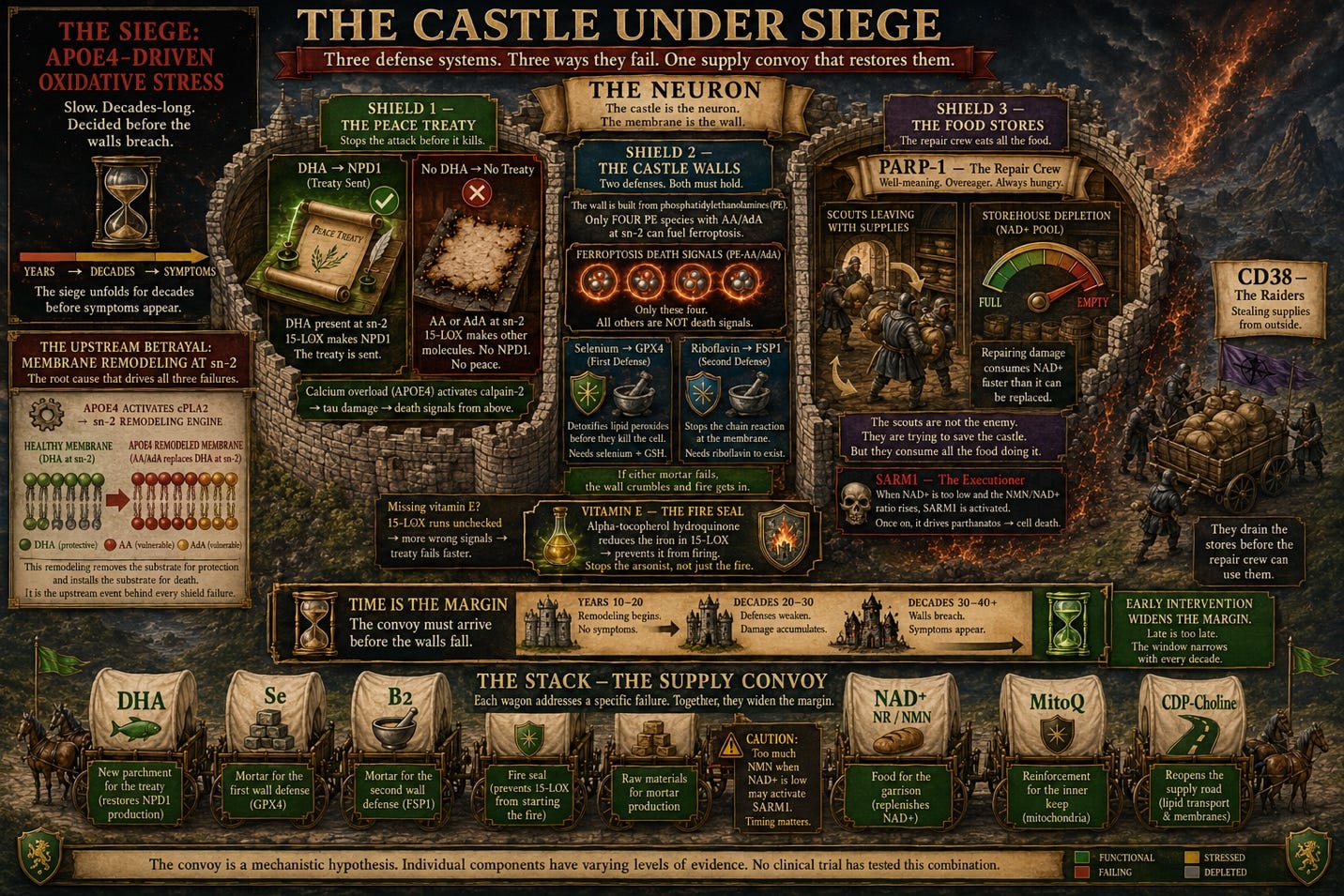
Imagine your brain cell is a castle.
It has been standing for decades. It has thick walls, a peace treaty system that can stop attacks before they become lethal, and a storehouse full of food to keep the garrison alive during hard times. It was built to survive.
But a siege has been underway for years — so slow you would never notice it. The walls have been quietly rebuilt with weaker stone. The parchment needed to write the peace treaty has been burned. And the food stores are being drained from two directions at once.
This is what APOE4 does to a neuron. Not all at once. Not dramatically. Over decades.
This article is the lay reader’s guide to the most mechanistically dense piece in the NeuroLipid Notebook series — “The Kill Switch(es): Three Death Pathways, Three Rescues, One Missing Substrate.” That article maps the full molecular detail. This one gives you the architecture first, so you can navigate the detail when you are ready.
Keep reading with a 7-day free trial
Subscribe to NeuroLipid Notebook to keep reading this post and get 7 days of free access to the full post archives.