
Melatonin as a Mitochondrial Guardian in Neurodegeneration
What the New MDPI Review Teaches Us

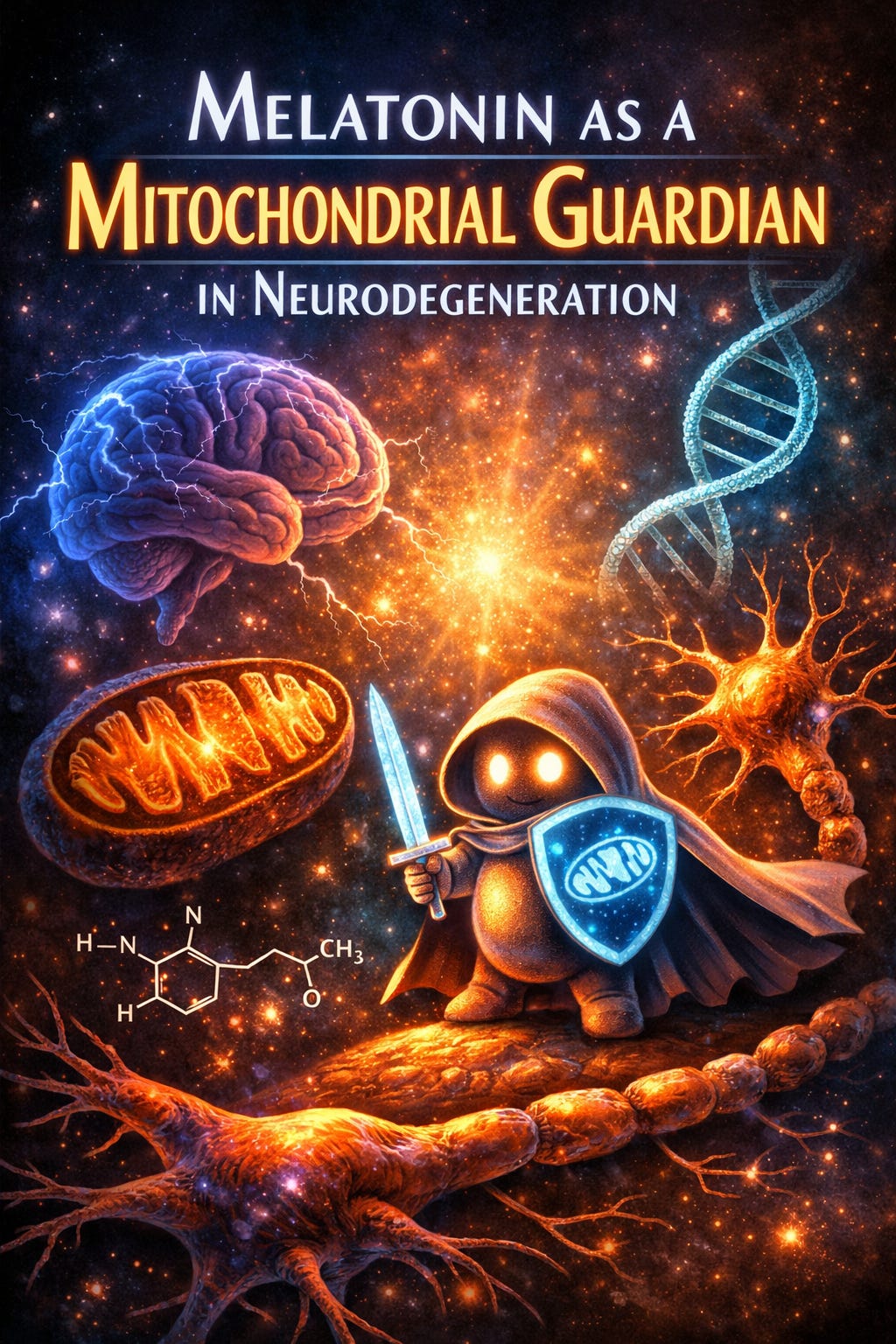
Neurodegenerative diseases are relentlessly linked with mitochondrial dysfunction, yet therapeutic translation has been frustratingly elusive. A new open-access review in MDPI Biology (2026) offers a rigorous update on how melatonin — the indoleamine we typically associate with sleep — may play a much deeper role in mitochondrial resilience and neuroprotection.[1][2]
Here’s what this means for understanding neurodegenerative pathophysiology — and where melatonin might realistically fit into translational strategies.
🧠 Mitochondria in Neurodegeneration — A Central Hub
Mitochondria are not merely cellular powerhouses; they are signaling nodes that:
- Govern oxidative phosphorylation (ATP production)
- Regulate ROS generation and scavenging
- Coordinate apoptosis and mitophagy
- Serve as hubs for immune signaling and stress responses
In neurodegenerative diseases such as Alzheimer’s, Parkinson’s, and Huntington’s, mitochondrial dysfunction often appears early — driving oxidative stress, impaired energy metabolism, and enhanced susceptibility to proteotoxic stress.[1][3]
In other words: mitochondria aren’t just collateral damage — they’re prime suspects.
🌙 Melatonin — More Than a Sleep Molecule
The MDPI review emphasizes that melatonin is far more than a chronobiotic:
- It is amphiphilic — allowing it to penetrate membranes and enter subcellular compartments
- It accumulates in mitochondria against a concentration gradient, likely via active transport through oligopeptide transporters[4]
- Its levels decline with age and in neurodegenerative conditions[2][3]
So when we lose melatonin in older age or with AD, what we lose isn’t just a good night’s sleep — we may be losing a local mitochondrial protective buffer.
🔬 Multi-Level Mechanisms of Mitochondrial Protection
1. Antioxidant Defense
Melatonin is a direct scavenger of free radicals and also upregulates endogenous antioxidants (superoxide dismutase 2, glutathione peroxidase) via the SIRT3/FOXO pathway, helping to counteract ROS and RNS generated by failing electron transport chain activity.[3][5]
2. Membrane Integrity Permeability
By protecting phospholipids like cardiolipin, melatonin helps stabilize the mitochondrial inner membrane and reduce the opening of the mitochondrial permeability transition pore (mPTP) — a key event in cell death pathways.[4][6]
3. Electron Transport Chain (ETC) Support
Emerging evidence suggests melatonin can enhance ETC complex function, preserving membrane potential and ATP output — critical in high-energy demanding neurons.[3][6]
4. Modulating Dynamics Quality Control
Beyond antioxidation, melatonin influences mitochondrial fission/fusion balance, mitophagy, and stress signaling pathways that govern organelle turnover and adaptation.[4][7]
🧩 Why This Matters for Neurodegeneration
Two key insights from the emerging literature now converge:
- Mitochondrial dysfunction is not a bystander in neurodegeneration — it’s a driver, amplifying oxidative stress, metabolic derangement, and pro-inflammatory signaling[1][3]
- Melatonin’s roles extend deep into mitochondrial biology, offering theoretical mechanisms to modulate these early pathological processes[2][8]
This dual perspective reframes melatonin not just as a sleep aid, but as a mitochondrial modulator that may help buffer against the energetic and redox stresses neurons face long before clinical symptoms emerge.
🚦 Caveats and Expectations
Before you stockpile pills, here’s what the evidence doesn’t yet prove:
❌ Melatonin is not yet a proven disease-modifying therapy in human neurodegeneration
❌ Mechanistic benefits seen in vitro or in animal models don’t automatically translate to clinical efficacy
❌ Timing and dosing that might protect mitochondria are not yet established in humans
What the MDPI review does do is provide a biologically plausible framework to test melatonin in early disease stages — especially where mitochondrial stress precedes irreversible neuronal loss.[1]
🧬 Special Relevance for APOE4 Carriers
For the approximately 25% of the population carrying at least one APOE ε4 allele — the strongest genetic risk factor for late-onset Alzheimer’s disease — melatonin may offer particularly relevant neuroprotective mechanisms.
The ApoE4-Melatonin Connection
